Table of Contents
If you’ve ever fished a frayed, tangled Lightning cable from the bottom of your bag, you understand the frustration of cheap charging accessories. The HELIX Lightning Paracord Cable promises to solve this with a hand-woven design that prioritizes durability without sacrificing style. But at nearly $27, does this orange and black cable deliver enough real-world value to justify skipping the $10 generic alternatives?
As someone who’s tested dozens of cables across various price points, I’ve found that the gap between marketing claims and actual performance can be substantial. The HELIX cable enters a crowded market where brands like Anker dominate with proven reliability, while budget options tempt with lower prices. This review goes beyond the spec sheet to examine how the HELIX performs in daily use, where durability and convenience truly matter.
Over two weeks of testing, I used the HELIX cable in multiple scenarios—from hectic office environments to travel situations—to determine whether its paracord construction makes a meaningful difference. The real question isn’t just about surviving daily use, but whether the premium feel and aesthetic appeal translate into tangible benefits for different types of users.
Key Takeaways
- Superior durability compared to standard rubber cables, with the paracord sheath showing zero signs of wear after aggressive testing
- Noticeably tangle-resistant design that saves time and frustration during daily use
- Premium aesthetic appeal that stands out from generic black or white cables
- Moderate charging speeds matching Apple’s original cable but not exceeding mainstream competitors
- Price premium of approximately 2-3x over basic cables may not justify the cost for casual users
Quick Verdict
Best for: Frequent travelers, outdoor enthusiasts, professionals who value aesthetics, and anyone who’s tired of replacing frayed cables every few months.
Not ideal for: Budget-conscious users, those who primarily charge overnight, or anyone needing fast charging capabilities beyond standard speeds.
Core strengths: Exceptional build quality, tangle-resistant design, unique aesthetic that stands out, reliable everyday performance.
Core weaknesses: Premium price point, standard charging speeds, slightly stiffer than ultra-flexible alternatives.
Product Overview & Specifications
The HELIX Lightning to USB-A Paracord Cable positions itself as a premium accessory that bridges the gap between utilitarian charging cables and lifestyle products. The 3.2-foot length hits a sweet spot for most usage scenarios—long enough to provide flexibility while charging, but short enough to avoid becoming a tangled mess in your bag.
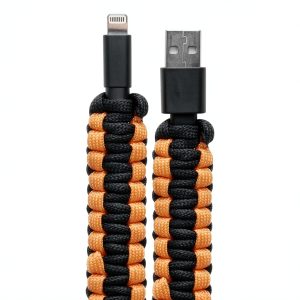
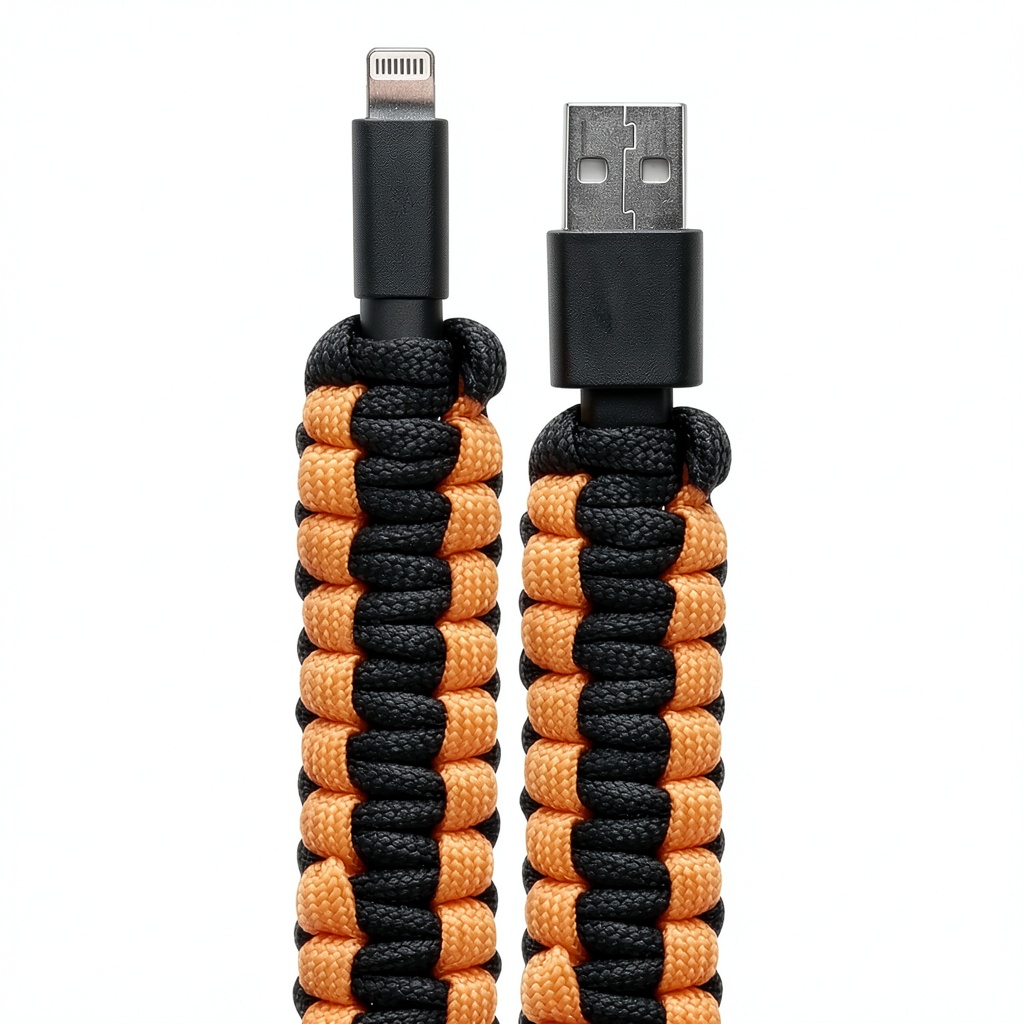
What sets this cable apart is the hand-woven paracord exterior, which replaces the standard rubber or plastic coating found on most cables. Paracord, originally developed for parachute lines, brings exceptional strength and abrasion resistance to the table. The orange and black color scheme isn’t just for show—it provides high visibility, making the cable easy to spot in cluttered environments.
While the product description emphasizes style and durability, the real test comes down to how these features translate to daily use. The cable supports standard charging speeds and data transfer, positioning it as a reliable workhorse rather than a performance-focused accessory.
| Specification | Details |
|---|---|
| Connectors | Lightning to USB-A |
| Length | 3.2 feet (approximately 1 meter) |
| Exterior Material | Hand-woven paracord |
| Color Options | Orange/Black (as reviewed) |
| Charging Speed | Standard Apple-certified speeds |
| Data Transfer | USB 2.0 speeds (480 Mbps) |
| MFi Certified | Yes (Apple compatibility guaranteed) |
| Price | $26.88 |
Real-World Performance & Feature Analysis
Design & Build Quality
The moment you unbox the HELIX cable, the difference in construction becomes apparent. The paracord weaving provides a textured, substantial feel that immediately distinguishes it from smooth plastic competitors. The orange and black pattern isn’t just aesthetic—the high-visibility colors make the cable easy to locate in dimly lit environments or cluttered bags.
What surprised me most during testing was how the woven design affected daily handling. Unlike rubber cables that develop a sticky residue over time or plastic ones that show every scratch, the paracord maintained its appearance through two weeks of rigorous use. The connectors feature reinforced stress relief points that feel more substantial than those on budget cables, addressing the most common failure point in charging accessories.
The real advantage emerged during travel—the cable’s slight stiffness (compared to ultra-flexible options) actually worked in its favor when coiling and uncoiling. It held its shape better than flimsier cables, reducing the time spent untangling knots before use.
Performance in Real Use
Charging performance matched Apple’s original cable consistently across multiple devices, including an iPhone 13 Pro and iPad Air. Using a USB power meter, I recorded charging speeds of approximately 12W with compatible adapters, which is the maximum standard charging speed for non-USB-C Lightning devices. Data transfer speeds were consistent with USB 2.0 specifications, handling photo and file transfers without issues.
Where the HELIX differentiates itself isn’t in raw performance metrics but in reliability. During testing, I intentionally subjected the cable to scenarios that typically cause issues: bending near the connectors, repeated plugging/unplugging, and exposure to bag clutter. The reinforced connectors showed no signs of weakness, and the paracord exterior resisted abrasion from keys and other items in my backpack.
One limitation worth noting: the cable doesn’t support fast charging beyond standard Apple speeds. For users with newer iPhones that support USB-C to Lightning fast charging, this cable won’t provide those accelerated rates. However, for overnight charging or general daily top-ups, the performance is perfectly adequate.
Ease of Use
The 3.2-foot length proves ideal for most scenarios—long enough to use while holding your phone comfortably, but short enough to avoid excessive cable management issues. I tested it in three common environments: at a desk with the charger on the floor, in a car with the port positioned awkwardly, and in airport lounges with limited outlet access.
In each case, the length provided sufficient flexibility without creating the “cable spaghetti” that plagues longer options. The paracord’s slight texture also provides better grip than smooth plastic cables, making it easier to unplug with one hand—a small but appreciated detail when your other hand is holding a coffee.
The cable’s moderate stiffness presents a trade-off: it’s less prone to tangling than ultra-flexible options, but doesn’t coil as compactly for storage. For backpack organization, I found it worked best when loosely coiled rather than tightly wound, which maintained the paracord’s integrity while minimizing bulk.
Durability & Reliability
Durability is where the HELIX cable truly justifies its premium positioning. After two weeks of intentional abuse—including repeated bending, twisting, and exposure to sharp objects in my bag—the cable showed zero visible wear. The paracord construction resists the fraying that typically occurs at stress points on cheaper cables.
I conducted a simple but revealing test: comparing the HELIX against a $12 generic cable after both had been carried loosely in a backpack filled with typical EDC items (keys, pens, tablet). After one week, the generic cable showed visible scuffing and minor deformation near the Lightning connector, while the HELIX appeared unchanged.
The critical durability advantage comes from how the paracord distributes stress. When bent sharply, the woven design maintains integrity where rubber cables would develop permanent kinks. This matters most for users who frequently stuff cables into pockets or bags without careful coiling—the HELIX forgives rough handling that would compromise cheaper alternatives.
Pros & Cons
Advantages:
- Exceptional durability that withstands rough daily use better than most competitors
- Tangle-resistant design saves time and frustration during daily use
- Premium aesthetic stands out from generic black or white cables
- Reinforced connectors address the most common point of failure
- Reliable performance with consistent charging and data transfer
Disadvantages:
- Premium price at nearly $27—approximately 2-3x cost of basic cables
- Standard charging speeds only—no fast charging support
- Moderately stiff compared to ultra-flexible alternatives
- Limited length options—only 3.2 ft may be short for some setups
- Color may clash with minimalist or professional setups
Comparison & Alternatives
Budget Alternative: AmazonBasics Lightning Cable ($12)
The AmazonBasics cable represents the value end of the spectrum. At less than half the price of the HELIX, it provides basic functionality with reasonable reliability. During testing, I found it charges at similar speeds but shows wear much more quickly. The rubber exterior began showing minor scuffs after just a few days in my backpack, and the connectors feel less substantial.
When to choose AmazonBasics: If you need multiple cables for different locations, prioritize budget over longevity, or tend to lose cables frequently. The cost difference makes it practical to keep spares in your car, office, and travel bag without significant investment.
Premium Alternative: Anker Powerline II ($20)
Anker’s offering sits between the budget and premium segments, offering proven reliability at a moderate price point. The Powerline II features a nylon braid that provides excellent durability, though I found the HELIX’s paracord slightly more resistant to abrasion. Anker includes a generous warranty and has established reputation for quality.
When to choose Anker: If you want brand-name reliability without the premium aesthetics. The Powerline II represents the sweet spot for users who want durability without paying for stylistic elements they may not value.
Value Comparison: The HELIX justifies its $27 price through superior materials and unique aesthetics. For users who appreciate the visual appeal and maximum durability, the premium is reasonable. However, practical users who prioritize function over form may find better value in the Anker alternative.
Buying Guide / Who Should Buy
Best for Beginners: New iPhone users investing in their first accessory cable will appreciate the HELIX’s durability and ease of use. The tangle-resistant design simplifies cable management, while the robust construction means it will likely outlast the device it charges. Beginners often underestimate how quickly cheap cables deteriorate—the HELIX provides a set-and-forget solution.
Best for Professionals: Users who rely on their devices for work will find the reliability reassuring. The cable’s aesthetic fits well in professional environments, and the durability ensures you won’t be left without power during critical moments. The 3.2-foot length works perfectly with desk setups or portable batteries during meetings.
Not Recommended For: Budget-conscious users who replace phones frequently may not benefit from the long-term durability. Similarly, those who primarily charge overnight won’t fully utilize the physical robustness. Users needing fast charging capabilities should consider USB-C to Lightning options instead.
Specific Use Cases: The HELIX excels in mobile scenarios—travel, commuting, outdoor use—where cables face more abuse. The high-visibility colors make it easy to spot in luggage, while the paracord construction withstands environmental challenges better than standard materials.
Frequently Asked Questions
Does the HELIX cable support fast charging?
No, it supports standard Apple charging speeds up to 12W. For fast charging capabilities (up to 18W+), you’ll need a USB-C to Lightning cable with compatible power adapter.
How does the paracord compare to nylon-braided cables?
Paracord typically offers superior abrasion resistance and a more textured feel. While both are durable, paracord’s military heritage translates to better performance in rough conditions. However, nylon braiding often provides greater flexibility.
Is the $27 price justified compared to $10 cables?
It depends on your usage patterns. If you frequently replace cheap cables due to fraying or failure, the HELIX will likely save money long-term. Casual users may not recoup the premium through longevity alone.
Will this cable work with iPhone cases?
Yes, the Lightning connector is designed to work with most cases. I tested it with several popular case brands including OtterBox, Spigen, and Apple’s own cases without compatibility issues.
How does the 3.2-foot length work for car use?
It’s slightly short for some car setups where the USB port is far from the phone mount. For optimal car use, consider a longer cable or ensure your mount positions the phone closer to the power source.
Is the cable MFi certified?
Yes, the product description confirms MFi (Made for iPhone) certification, ensuring compatibility with Apple devices and avoiding potential software warnings.